30-Day HIIT Challenge: A Complete Workout Plan with Timer Settings
A progressive 30-day HIIT challenge with exact timer configurations for every week. No equipment, no gym — just you and a timer.
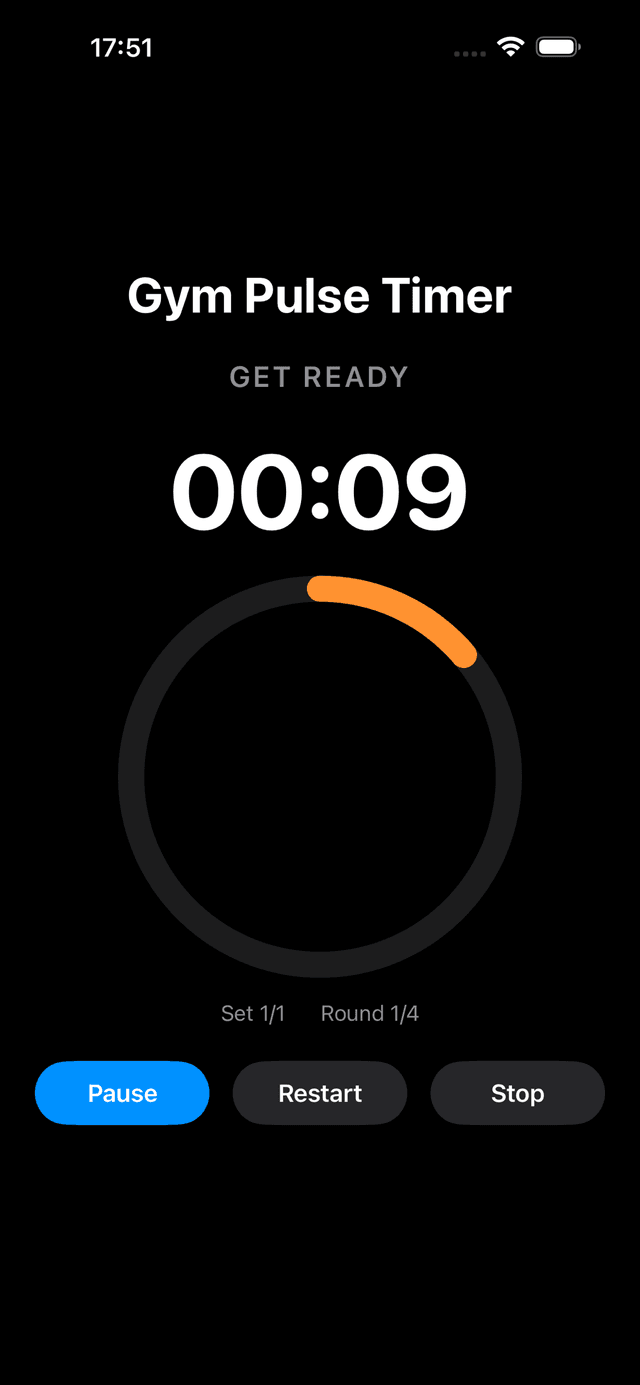
Day 1, round 1 — the Get Ready countdown gives you 5–10 seconds to get into position before the first work interval.
How This 30-Day HIIT Challenge Works
Most 30-day challenges fail because they give you the same workout from day one to day thirty. Your body adapts quickly, and by week two you're barely breaking a sweat. This plan is different. It uses progressive overload through timer settings — each week the work intervals get longer, rest intervals get shorter, and the total number of rounds increases.
The structure is simple: 5 workout days + 2 rest days every week. Rest days fall on Wednesday and Sunday so your body has time to recover mid-week and before the next week begins. No equipment is needed — every exercise is bodyweight only, and every workout can be done in your living room, a park, or a hotel room.
Each week comes with an exact GymPulseTimer preset configuration. Save each one and switch with a single tap when the new week starts. On iPhone, the app's Live Activity keeps the timer visible on your Lock Screen so you never have to fumble with your phone mid-burpee.
By day 30, you'll be doing workouts that would have crushed you on day one — and you'll have the presets to prove how far you've come.
Week 1: Foundation (Days 1–7)
The first week is all about building the habit and learning proper form at a manageable intensity. The 1:2 work-rest ratio gives you twice as much recovery as effort, so even if you're completely new to HIIT, you'll be able to finish every round.
Week 1 Preset: Foundation
Warm-up: 5 minutes light jogging or jumping jacks
Work: 20 seconds
Rest: 40 seconds
Rounds: 6
Total: 6 minutes (plus warm-up & cool-down)
Exercises (rotate each round):
- Bodyweight squats (round 1)
- Push-ups or modified push-ups (round 2)
- Jumping jacks (round 3)
- Mountain climbers (round 4)
- Plank hold (round 5)
- Bodyweight squats (round 6)
| Day | Type | Focus |
|---|---|---|
| Mon (Day 1) | Workout | Full body circuit |
| Tue (Day 2) | Workout | Lower body emphasis |
| Wed (Day 3) | Rest | Active recovery (walk or stretch) |
| Thu (Day 4) | Workout | Upper body emphasis |
| Fri (Day 5) | Workout | Full body circuit |
| Sat (Day 6) | Workout | Core & conditioning |
| Sun (Day 7) | Rest | Full rest day |
Tip: Save this as “Week 1 — Foundation” in GymPulseTimer so you can reload it any time.
Week 2: Build (Days 8–14)
You survived the first week — now it's time to push. Week 2 adds 5 seconds of work and shaves 5 seconds off rest, shifting you closer to a 1:1.5 ratio. You also jump from 6 to 8 rounds, which adds real volume. The exercises get slightly harder too: regular push-ups replace modified ones, lunges replace squats on some days, and high knees replace jumping jacks.
Week 2 Preset: Build
Warm-up: 5 minutes dynamic stretching
Work: 25 seconds
Rest: 35 seconds
Rounds: 8
Total: 8 minutes (plus warm-up & cool-down)
Exercises (rotate each round):
- Alternating lunges (round 1)
- Push-ups (round 2)
- High knees (round 3)
- Mountain climbers (round 4)
- Squat jumps (round 5)
- Plank shoulder taps (round 6)
- Burpee walk-outs (round 7)
- Alternating lunges (round 8)
| Day | Type | Focus |
|---|---|---|
| Mon (Day 8) | Workout | Full body circuit |
| Tue (Day 9) | Workout | Lower body & cardio |
| Wed (Day 10) | Rest | Active recovery (yoga or walk) |
| Thu (Day 11) | Workout | Upper body & core |
| Fri (Day 12) | Workout | Full body circuit |
| Sat (Day 13) | Workout | Conditioning & endurance |
| Sun (Day 14) | Rest | Full rest day |
By the end of Week 2, you should notice that 25 seconds of work feels manageable. Your transitions between exercises will be smoother, and you'll recover faster during rest intervals. This is progressive adaptation in action.
Week 3: Intensity (Days 15–21)
This is where the challenge truly begins. The ratio flips to 3:2 — more work than rest for the first time. At 30 seconds on and 20 seconds off with 8 rounds, the total work time nearly doubles compared to Week 1. Two days this week also include a Tabata-style finisher: after your main circuit, you'll do one final set of 20 seconds all-out / 10 seconds rest for 4 rounds on a single exercise.
Week 3 Preset: Intensity
Warm-up: 5 minutes dynamic stretching + 1 minute light jog
Work: 30 seconds
Rest: 20 seconds
Rounds: 8
Total: ~7 minutes main circuit (plus Tabata finisher on select days)
Exercises (rotate each round):
- Jump squats (round 1)
- Push-ups with rotation (round 2)
- High knees (round 3)
- Burpees (round 4)
- Alternating reverse lunges (round 5)
- Plank to push-up (round 6)
- Skater jumps (round 7)
- Mountain climbers (round 8)
Exercise progressions from earlier weeks: Regular squats become jump squats. Standard push-ups add a rotation at the top. Static planks become plank-to-push-up transitions. Each progression adds either an explosive or stability component, forcing your body to recruit more muscle fibers in the same time window.
| Day | Type | Focus |
|---|---|---|
| Mon (Day 15) | Workout | Full body circuit |
| Tue (Day 16) | Workout + Tabata | Lower body + Tabata finisher (jump squats) |
| Wed (Day 17) | Rest | Active recovery (foam rolling) |
| Thu (Day 18) | Workout | Upper body & core |
| Fri (Day 19) | Workout + Tabata | Full body + Tabata finisher (burpees) |
| Sat (Day 20) | Workout | Conditioning & endurance |
| Sun (Day 21) | Rest | Full rest day |
For Tabata finisher days, create a separate “Tabata Finisher” preset in GymPulseTimer (20s work / 10s rest, 4 rounds). Run it immediately after your main circuit.
Week 4: Peak (Days 22–30)
This is the hardest week — and it's 9 days instead of 7 to close out the full 30. The main circuit runs at 30 seconds work / 15 seconds rest for 10 rounds, a 2:1 work-rest ratio that will test everything you've built over the last three weeks. Two days feature a full Tabata protocol (20s/10s for 8 rounds) as the primary workout instead of a finisher.
Week 4 Preset: Peak
Warm-up: 5 minutes dynamic stretching + 2 minutes light cardio
Work: 30 seconds
Rest: 15 seconds
Rounds: 10
Total: ~7.5 minutes main circuit (plus Tabata days)
Exercises (rotate each round):
- Burpees (round 1)
- Push-ups with rotation (round 2)
- Jump squats (round 3)
- Mountain climbers (round 4)
- Plank to push-up (round 5)
- Skater jumps (round 6)
- Tricep dips on floor (round 7)
- High knees (round 8)
- Alternating reverse lunges (round 9)
- Burpees (round 10)
Tabata Day Preset (Days 25 & 28)
Work: 20 seconds
Rest: 10 seconds
Rounds: 8
Total: 4 minutes (the hardest 4 minutes of your life)
Pick one exercise and go all-out every round:
- Day 25: Burpees
- Day 28: Jump squats
| Day | Type | Focus |
|---|---|---|
| Mon (Day 22) | Workout | Full body peak circuit |
| Tue (Day 23) | Workout | Lower body & explosive |
| Wed (Day 24) | Rest | Active recovery (light stretching) |
| Thu (Day 25) | Tabata Day | Burpee Tabata (20s/10s × 8) |
| Fri (Day 26) | Workout | Full body peak circuit |
| Sat (Day 27) | Workout | Upper body & core |
| Sun (Day 28) | Tabata Day | Jump squat Tabata (20s/10s × 8) |
| Mon (Day 29) | Workout | Full body peak circuit |
| Tue (Day 30) | Test Day | Repeat Week 1 workout — feel the difference |
Day 30 is the real reward. Load your “Week 1 — Foundation” preset (20s work, 40s rest, 6 rounds) and run the exact workout you started with on Day 1. The exercises that had you gasping for air four weeks earlier will feel almost easy. That gap between how it felt then and how it feels now is a concrete measure of your progress.
Full 30-Day Progression at a Glance
| Week | Work | Rest | Rounds | Ratio |
|---|---|---|---|---|
| 1 — Foundation | 20s | 40s | 6 | 1:2 |
| 2 — Build | 25s | 35s | 8 | ~1:1.4 |
| 3 — Intensity | 30s | 20s | 8 | 3:2 |
| 4 — Peak | 30s | 15s | 10 | 2:1 |
How to Track Your Progress and What Comes Next
The simplest way to track this challenge is through your presets. Save each week as a named preset in GymPulseTimer — “Week 1 — Foundation,” “Week 2 — Build,” and so on. When you open the app on Day 30 and see all four presets lined up, you have a visual log of exactly how far you've progressed. GymPulseTimer is one of the best interval timer apps with no subscription — free to start, with a single $4.99 one-time Pro upgrade.
Beyond presets, keep a simple note of how each workout felt. A quick rating from 1 (easy) to 5 (barely survived) after each session gives you data to look back on. You'll notice your Week 3 ratings dropping as your body adapts — that's the signal that the challenge is working.
After 30 days, you have several paths forward:
- Repeat with harder exercises. Keep the same timer progressions but swap in more demanding movements — tuck jumps instead of jump squats, diamond push-ups instead of regular, pistol squat progressions instead of lunges.
- Try dedicated protocols. Full Tabata sessions (8 rounds of 20s/10s), EMOM workouts (every minute on the minute), or AMRAP circuits (as many rounds as possible) are all natural next steps. GymPulseTimer supports every format.
- Extend session length. Bump to 12–15 rounds at the Week 4 settings for longer workouts that build muscular endurance alongside cardiovascular fitness.
- Add equipment. Introduce a kettlebell, resistance bands, or a jump rope to your intervals. The timer settings stay the same — only the exercises change.
Whatever you choose, you now have a baseline fitness level and a set of timer presets to build from. The hardest part — starting — is behind you.
Start the 30-Day HIIT Challenge
Download GymPulseTimer on iPhone or Android, save your Week 1 preset, and begin today. Free to start — no subscription required.